IUCN categories describe extinction risk. A global category can differ from a local population assessment. Least Concern does not mean an animal faces no threats.
Loggerhead sea turtle
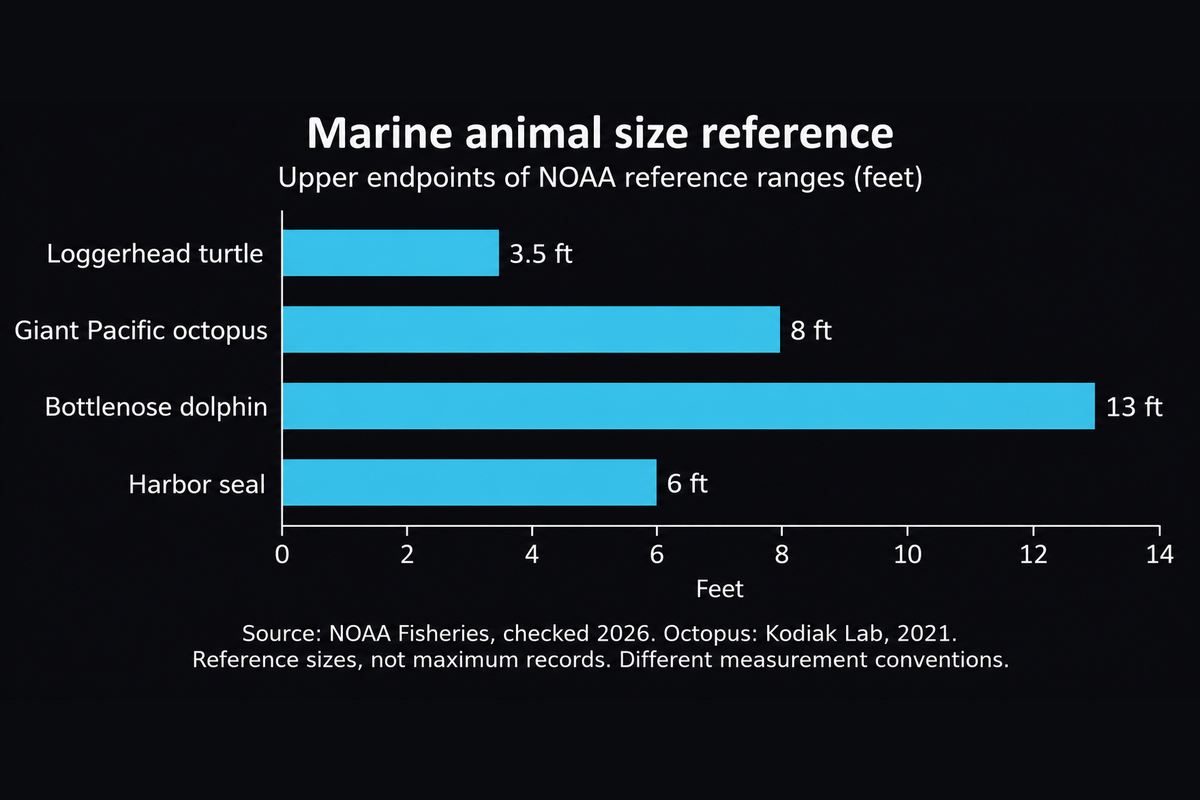
Caretta caretta has a large head and strong jaws. NOAA gives an adult length of 2.5–3.5 feet. Its identification guide describes shell size, so exclude the plush head and flippers when comparing.
NOAA estimates a lifespan of 70 years or more, while noting uncertainty. The IUCN Marine Turtle Specialist Group lists the species globally as Vulnerable. Fishing gear and nesting habitat loss remain threats.
Sources: NOAA Fisheries; IUCN Marine Turtle Specialist Group. Checked 2026.
Giant Pacific octopus
Enteroctopus dofleini has eight arms. NOAA's Kodiak Lab reports an average length range of 6–8 feet and a lifespan of 3–5 years. A plush head measurement alone cannot represent that arm-inclusive size.
The arms carry suckers along their length. NOAA describes a diet that includes fish, crabs, and snails. This is an invertebrate: an animal without a backbone.
Source: NOAA Fisheries, “A View From Inside the Kodiak Lab Aquarium — Post 4,” 2021.
Common bottlenose dolphin
Tursiops truncatus measures 6–13 feet in NOAA's profile. Its listed lifespan is 40–60 years. These broad ranges make a single “life-size dolphin” label unhelpful without a measurement.
The IUCN Cetacean Specialist Group lists the species as Least Concern globally. NOAA identifies fishing gear entanglement, pollution, and vessel strikes among its threats. A global category does not describe each local population.
Sources: NOAA Fisheries; IUCN Cetacean Specialist Group. Checked 2026.
Harbor seal
Phoca vitulina measures about 5–6 feet and lives about 25–30 years, according to NOAA. Harbor seals lack external ear flaps. Their short front flippers help distinguish their shape from a sea lion.
The Convention on Migratory Species reports the IUCN category as Least Concern. NOAA lists disturbance and entanglement among the threats. A resting seal on land does not automatically need help.
Sources: NOAA Fisheries; Convention on Migratory Species. Checked 2026.
Great white shark
Carcharodon carcharias can reach 21 feet in NOAA's adult size summary. NOAA lists a lifespan of 70 years or more. That length is an upper value, not an ordinary adult range.
The Convention on Migratory Species reports its global IUCN category as Vulnerable. NOAA identifies bycatch and overfishing as threats. Compare a shark plush with this species only if it represents a white shark.
Sources: NOAA Fisheries; Convention on Migratory Species. Checked 2026.
Blue whale
Balaenoptera musculus can reach 110 feet, according to NOAA. Its estimated average lifespan is 80–90 years. NOAA identifies it as the largest animal on Earth.
The IUCN Cetacean Specialist Group lists the species as Endangered. NOAA identifies vessel strikes and fishing gear entanglement as threats. A maximum length should not become the lower end of a made-up range.
Sources: NOAA Fisheries; IUCN Cetacean Specialist Group. Checked 2026.
Ocellaris clownfish
Amphiprion ocellaris is much smaller. The US Geological Survey profile gives a maximum total length of 90 millimetres. A large clownfish plush can exceed this reference size.
Sahm and colleagues recorded captive ocellaris clownfish older than 20 years in their 2019 study. That finding does not establish an average wild lifespan. The IUCN assessment from 2021, published in 2022, lists Least Concern.
Sources: USGS, checked 2026; Sahm et al., 2019; IUCN Red List, 2022.